
Picking the right index fund comes down to choosing the right car engine for long drives, not predicting the race winners. The Best Index Funds would not be those that have generated the biggest gains in the past, the most popular funds, or the cheapest funds one may find on the Internet. Ideally, the best fund would align with one’s money management goals, provide good market coverage, track the benchmark accurately, and remain understandable in bad times. That is extremely important in 2026 because a number of broad indexes are significantly affected by just a few giant corporations.
Getting that alignment right starts with knowing what each holding is actually for.
Start With the Fund’s Purpose
Every investment holding must have its own main objective. The total market equity portfolio can be utilised for growth, while the international portfolio can be used to reduce dependence on a single country, and the bonds can serve as a balancing element or even as a source of withdrawal funds for the future. Otherwise, it is very easy to complicate things and end up with a confusing collection of investments with no objective.
Start with an imperative sentence such as “This fund will provide a diversified portfolio of US equities for retirement accounts, and it will be invested in for at least 15 years.” The sentence will become the criterion against which all other decisions will be made. There is no way to improve such a product at a low cost or with good graphics.
Read the Benchmark Before the Brand
An index fund does not promise to outperform or avoid losses. It follows a rules-based benchmark and aims to deliver approximately the benchmark’s return before expenses and implementation differences. Some funds hold every index security; others sample the index or use derivatives.
The benchmark determines what the investor truly owns. Two products labelled “broad market” may use different eligibility rules, rebalancing schedules, or company-size limits. Strong long-term investing, therefore, requires reading the index description rather than relying on a familiar provider. Check entry rules, weighting, rebalancing, and which industries, countries, or bond types are excluded. The fund name is packaging; the benchmark drives the result.
Total-Market Choices for a US Core
A total-market fund seeks to capture a large share of the US public equity market in a single holding. ITOT tracks the S&P Total Market Index, listed a 0.03% expense ratio, and reported 2,475 holdings as of July 10, 2026. SCHB tracks the Dow Jones U.S. Broad Stock Market Index, which was also listed at 0.03%, and reported 2,356 holdings on July 13, 2026.
Neither is automatically superior, and both remain influenced by the largest companies. Either may serve as a central US holding.
Buying both usually creates overlap rather than doubling diversification. Brokerage access, automation, spreads, taxes, and benchmark preference are better tie-breakers than small past-return differences.
When the S&P 500 Is Sufficient
Some portfolios do not require a separate slice for every US company size. An S&P 500 fund provides exposure to large companies and is widely available in workplace retirement plans. IVV is one current example; its official page lists a 0.03% expense ratio and identifies the S&P 500 Index as its benchmark.
Its boundary is clear: it does not intentionally provide the same mid-cap and small-cap coverage as a total-market fund. That limitation does not make it unsuitable. The Best Index Funds must be judged across the complete household portfolio. An investor may own smaller companies elsewhere or prefer a simple large-cap core. Trouble begins when an S&P 500 fund, a growth fund, and a technology fund are combined without noticing that the same leading companies dominate each position.
International Exposure Without Performance Chasing
A US-only portfolio depends heavily on one market’s valuations, currency, regulation, and corporate leadership. A broad international fund spreads exposure across developed and emerging economies. IXUS tracks large-, mid-, and small-cap non-US equities through the MSCI ACWI ex USA IMI Index and lists a 0.07% expense ratio as of July 2026.
International diversification is not a prediction that overseas shares will win next year. It recognises that leadership changes over long periods. Thoughtful Index Fund Investing accepts that an international allocation may lag US stocks for years while still reducing dependence on a single country. Investors should examine country weights, emerging-market exposure, currency effects, withholding taxes, and fund domicile. A global label can hide important differences, so benchmark coverage matters.
Bonds Change How the Portfolio Feels
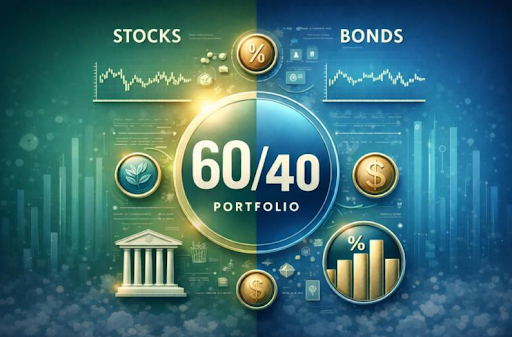
A long horizon does not require a portfolio made entirely of shares. High-quality bonds may reduce volatility, provide income, and create a rebalancing source after equity declines. AGG tracks the Bloomberg U.S. Aggregate Bond Index, offers broad US investment-grade bond exposure, and lists a 0.03% expense ratio in July 2026.
Bond funds are not risk-free. Prices can fall when interest rates rise, and credit conditions can affect some holdings. Their value should be judged by function rather than by a promise of safety. For many people, combining bonds with low cost funds holding equities makes the overall plan easier to maintain through difficult markets. The bond weight depends on withdrawal timing, income stability, cash reserves, and loss tolerance. A moderate portfolio followed consistently may work better than an aggressive one repeatedly abandoned.
Measure the Costs Investors Actually Pay
Expense ratios matter because they are deducted year after year, leaving less money to compound. Investor.gov shows how apparently modest fee differences can produce significantly different ending values over long periods. However, the expense ratio is only one part of the bill.
ETF bid-ask spreads, brokerage charges, platform fees, currency conversion, taxes, and unnecessary trading may also reduce returns. A fund charging 0.02% is not automatically better than one charging 0.03% if it tracks the wrong market or is difficult to buy efficiently. Good Long-Term Investing focuses on material differences. One basis point costs $1 per year per $10,000 invested. That perspective can stop investors from triggering taxes or spending time switching funds when the savings are too small to meaningfully improve the plan.
Tracking Quality Matters More Than Advertising
Real fund returns rarely match benchmark returns perfectly. Fees, transaction costs, cash balances, sampling, tax treatment, and securities lending may create a gap known as a tracking difference. Tracking error describes how much the gap varies.
Compare several years of official fund returns with the corresponding index returns. A small, consistent lag may be understandable. A larger or unstable gap deserves investigation. When choosing Stock Market Funds for decades, reliable implementation matters more than a single year’s league table. Confirm whether the benchmark has changed, since older performance may represent a different strategy. Read the prospectus explanation of sampling and derivatives. A low fee is useful, but it cannot compensate for a fund that repeatedly delivers results that differ unexpectedly from the index it claims to follow.
Detect Overlap Before Calling It Diversification
Owning five funds does not guarantee five independent sources of return. A total-market fund, an S&P 500 fund, a growth fund, and a technology fund may all rely on the same group of giant companies. The account looks busy, but the underlying economic exposure remains concentrated.
Review top holdings, sector weights, company-size profiles, and countries across every account, including workplace plans and all separately held retirement accounts. Even the Best Index Funds can be combined poorly when each purchase is evaluated in isolation. Concentration is not automatically wrong; it should simply be intentional. An investor who knowingly chooses extra technology exposure is making an allocation decision. Someone who creates it accidentally through overlapping funds is accepting risk without deciding how much is appropriate. A basic exposure sheet often reveals more than a ticker count.
ETF or Mutual Fund: Choose for Behaviour
ETFs trade on exchanges throughout the day at market prices. Traditional mutual funds are generally bought or redeemed at their calculated end-of-day net asset value. Investor.gov notes that ETFs pool investor money like mutual funds, trade on national securities exchanges, and can sometimes be more tax-efficient.
The better wrapper is the one that supports discipline. ETFs may offer portability, intraday liquidity, and wide availability. Mutual funds may make automatic contributions and exact-dollar purchases easier, depending on the provider. In Index Fund Investing, instant tradability can be a disadvantage when it encourages constant reaction trading. Check minimums, fractional-share access, purchase charges, transfer restrictions, and whether a platform-specific fund can be moved without selling. Convenience should support the plan, not interrupt it.
Match the Holding to the Account
Fund selection and account selection belong in the same conversation. The same investment may yield different after-tax results in a taxable brokerage account, a retirement account, an education account, or another tax-advantaged structure. Rules differ by country and may change, so general comparisons cannot replace local guidance.
Review dividend taxation, capital-gains treatment, foreign withholding, fund domicile, and withdrawal restrictions. Placing identical Low Cost Funds in every account may ignore useful asset-location opportunities, but extreme tax optimisation can make the portfolio difficult to manage. Aim for an efficient structure that can still be understood as one household plan. When the consequences are material, a qualified tax or financial professional familiar with the investor’s jurisdiction may help. Suitability comes before a small theoretical tax advantage.
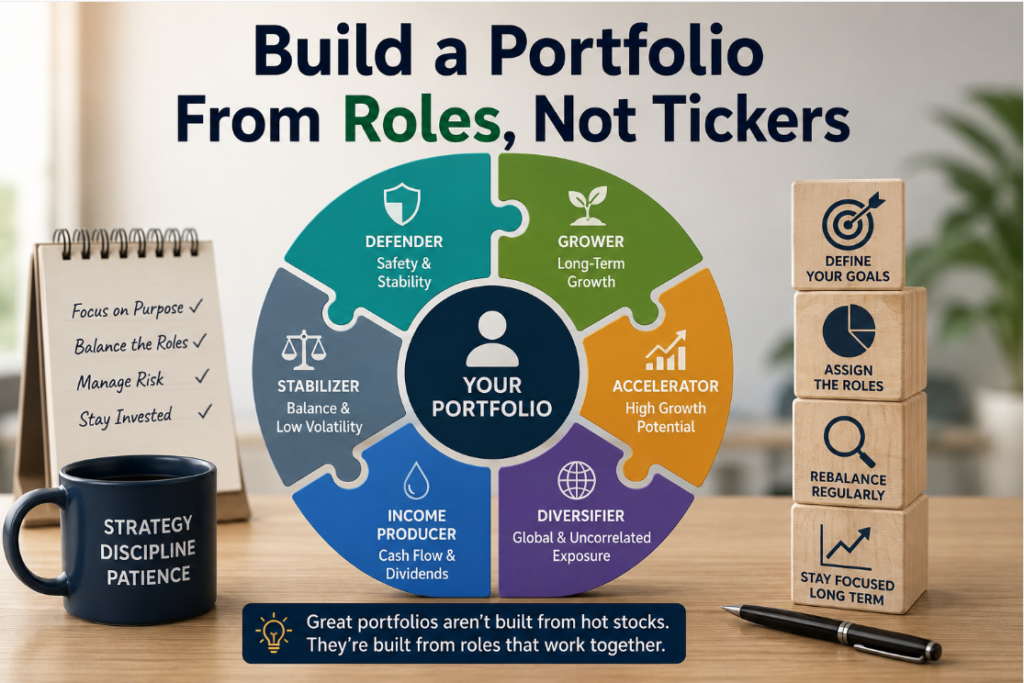
Build a Portfolio From Roles, Not Tickers
A durable portfolio may need only a few broad funds. Add another holding only when it supplies an exposure that is genuinely missing. Four structures illustrate the idea:
- One total US market fund when international and bond exposure already exists elsewhere.
- A broad US fund paired with a broad international equity fund.
- US equities, international equities, and an investment-grade bond fund.
- An S&P 500 fund combined with complementary choices available in a limited workplace plan.
In practice, Stock Market Funds belong in the portfolio only when their role is distinct, measurable, and genuinely missing.
These are frameworks, not recommendations. Allocation depends on goals, time horizon, risk tolerance, cash reserves, and planned withdrawals. Investor.gov explains that asset allocation is personal and should reflect the timeframe and tolerance for volatility. Successful Long-Term Investing comes from understanding the role of each component, not copying a model portfolio because its historical chart looks attractive.
Set a Buying Rule Before Volatility Arrives
A suitable fund can still produce a poor investor experience when purchases depend on excitement or fear. Decide how often money will be invested, which account will receive it, and how contributions will be divided among underweight assets. Automation reduces the pressure to interpret every economic release.
Lump-sum and staged investing involve different trade-offs. Investing immediately gives money more time in the market; staging may make it emotionally easier to follow through. The stronger method follows a written rule, not a prediction. With volatile Stock Market Funds, keep emergency savings separate so an unexpected bill does not force a sale. Define legitimate reasons to pause contributions, such as job loss or an urgent cash need, instead of stopping merely because prices have declined.
Review Annually Without Rebuilding Everything
Index investing needs less activity, not zero oversight. Once a year, compare every holding with the reason it was purchased. Check whether the benchmark, fee, mandate, provider, or structure has changed. Review overlap, tracking difference, account location, and whether the allocation still matches the goal.
One weak year is rarely enough reason to replace a broad fund. A persistent tracking problem, duplicated exposure, unsuitable account fit, or major benchmark change may be more relevant. The Best Index Funds remain appropriate only while their structure and role continue to support the plan. Before switching, estimate taxes, spreads, and time out of the market. A replacement should deliver a meaningful improvement after those costs. Annual maintenance should preserve clarity, not chase changing market leadership.
Conclusion
A strong index portfolio is built through clear roles, broad diversification, reasonable costs, and a process that remains usable during uncertain markets. Index Fund Investing works best when investors compare benchmarks, holdings, tracking, taxes, and account fit before purchasing. Recent performance should never replace that work. For InvestSmartlys readers, the practical lesson is to keep the portfolio understandable, automate contributions where appropriate, and review it without constantly rebuilding it. InvestSmartlys connects investing with personal finance and long-term wealth creation, making disciplined fund selection part of a wider plan. Patience, consistency, and suitable allocation matter more than finding a fashionable ticker.
Sources
- SEC Investor.gov — index funds, ETFs versus mutual funds, and how fees compound
- SEC Investor.gov — international investing and country concentration risk
- FINRA — comparing fund costs and understanding tracking differences
Expense ratios, holdings counts and benchmark details for ITOT, SCHB, IVV, IXUS and AGG come from each provider’s own published fund pages as of the dates stated, and change. Verify current figures in the prospectus before investing.
Last reviewed: 15 August 2026. Fund costs, holdings and benchmarks change — we review this article when they do.
General information only, not personalised investment advice. Funds named are examples used to illustrate structural differences, not recommendations. Investments can fall as well as rise, and past performance does not predict future results. Consult a qualified professional about your own circumstances.