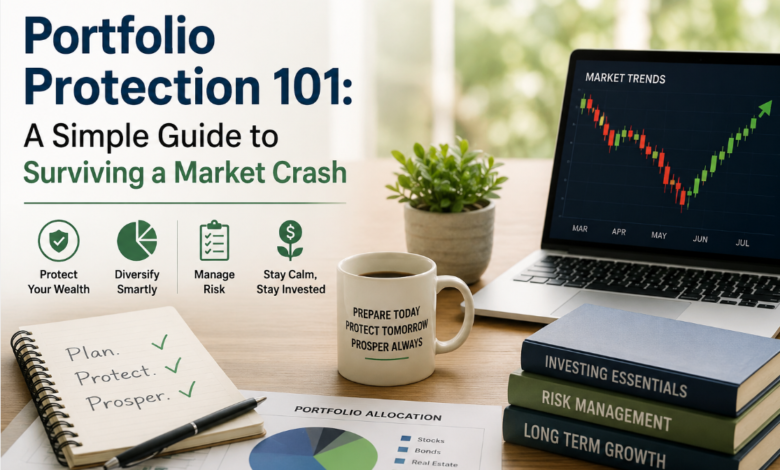
A declining market does not usually destroy a well-thought-out plan. However, real damage is usually caused by panic-induced behaviour, liquidating investments that should have been held for the long term to pay for current expenses, forgetting about diversification because of declining prices, or seeking an unknown shelter. Portfolio Protection starts with eliminating those circumstances that trigger hasty actions. The objective is not an account that will never go down. It is a framework that keeps the liquidity and freedom of choice of its owner.
The present manual adopts a survivalist perspective rather than predicting the next market crash. In addition, it relates the investment account to cash flows, debts, insurance, employment, and future needs. Such a perspective is important because a price decline may pose a personal risk if it occurs when an individual really needs money during the Market Crash. The concepts presented are purely educational and are not tailored advice for a particular individual. Different allocations and instruments suit different people in different countries.
Decide the Rules Before Fear Arrives
A cool-headed investor and a scared investor may analyse the same investment and reach opposing conclusions. Draft an action plan for your investments in a normal market environment. List the reasons to sell the investment, to rebalance it, and to take no action at all. This will reduce Investment Risk by replacing hasty decisions with predefined criteria. These criteria must be based on a failure of the investment scenario, a change in your objective, or a reduced investment horizon, never on some scary news item.
Separate Life Money From Growth Money
Give every financial goal an amount and a date. Rent, school fees, taxes, medical costs, or a house deposit due soon should not depend on assets that may be depressed when payment is required. During a Bear Market, this matters because one short-term obligation should not dictate an entire long-term portfolio. The SEC’s Investor.gov explains that asset allocation should reflect time horizon and risk tolerance, since investors with shorter horizons may prefer less volatile assets.
Do not ask only, “Can I tolerate a 25% decline?” Ask, “Which payment would force me to sell after a 25% decline?” That question uncovers weaknesses a standard questionnaire can miss. A secure employee and a self-employed investor may face very different pressures. Practical Portfolio Protection starts with obligations, not products. Once money is divided by purpose, it becomes easier to decide what needs stability, what needs growth, and what can remain untouched during recovery.
Build a Cash Runway With a Job

Cash can look unproductive while shares rise, yet its value changes when income stops or an urgent expense appears. A dedicated reserve may prevent a household problem from becoming a forced investment sale when cash is urgently needed during a Market Crash. Its size should reflect essential spending, income reliability, insurance, dependents, and available credit, not a universal online figure. The Consumer Financial Protection Bureau describes emergency savings as a reserve for unplanned costs and notes that even a small buffer can reduce reliance on debt or retirement withdrawals.
Find Concentration Outside the Fund Names
Owning several funds does not guarantee genuine diversification. Different products may hold the same companies, sectors, countries, or currencies. Review top holdings and major exposures rather than counting ticker symbols. Hidden overlap creates Investment Risk because one event can hit several positions together. Investor.gov warns that narrowly focused funds may not diversify adequately and recommends checking whether their holdings are genuinely different. Three technology-heavy indexes, for example, may create more concentration than one broad equity fund paired with an asset driven by different forces.
Concentration also exists outside the brokerage account. Salary, bonuses, employer shares, property, and a private business may all depend on the same company or local economy. Create a simple risk map showing where income, investments, pensions, and debt share the same driver. During a Bear Market, those links can weaken together. The aim is not to remove every connection. It is to stop one setback from damaging several areas of life simultaneously. This whole-household view is often more useful than adding another fund.
Separate Falling Prices From Broken Assets
A broad sell-off can pull both strong and weak investments down. Permanent damage is more likely when debt becomes unmanageable, a business model fails, fraud appears, dilution destroys value, or the original purchase was unsuitable. This distinction is central to Portfolio Protection. Revisit why each holding was bought and identify evidence that would invalidate the case. A lower price does not prove an asset is broken, and “it must recover” is not analysis. Funds also deserve review when their mandate, benchmark, cost, concentration, or tracking behaviour changes.
Give Every Holding One Main Responsibility
Portfolios become collections of ideas. One fund followed a podcast, another followed a strong year, and a third looked defensive. Under stress, the owner cannot tell what helps. Assign each holding one role: growth, income, stability, diversification, or liquidity. Investment Risk rises when unnecessary complexity hides what each position is meant to do. A high-dividend stock remains an equity; a long-duration bond may be high quality but rate-sensitive; a thematic ETF may hold many securities while depending on one narrow trend.
The job description should include expected weaknesses. A growth asset may fall sharply yet remain suitable for a distant goal. A stabilising asset may deliver modest returns while protecting near-term spending. Honest expectations help investors avoid abandoning a holding for behaving as designed. This strengthens Portfolio Protection when markets become uncomfortable. When two positions perform the same job, compare costs, liquidity, tax treatment, and underlying exposures. If neither offers a clear advantage, simplification may improve oversight and reduce the number of decisions required during volatility.
Rebalance with Boundaries, Not Predictions
Market moves gradually change a portfolio’s risk level. Rebalancing restores the chosen mix; it does not forecast the next direction. Set review dates or tolerance bands before the plan is tested by a Bear Market. Investor.gov notes that faster-growing assets can push holdings away from their intended allocation and that rebalancing returns them toward the original mix. New contributions can first support underweight areas, potentially reducing sales, costs, and taxable events. The target itself should still be reviewed when goals, income, age, or time horizon materially change.
Treat Gold as a Tool, Not a Promise
Gold may behave differently from shares and can diversify some portfolios, but it is not guaranteed to rise whenever equities fall. Before adding Gold ETFs, identify the actual exposure, expense structure, custody, liquidity, tax treatment, and redemption rules. Some hold metal; others use futures, derivatives, mining shares, or leverage. They are not interchangeable, and the allocation should solve a defined problem. Buying only after fear has increased demand can turn a planned diversifier into an emotional momentum trade.
Structure matters as much as the gold price. State Street says GLD seeks to reflect gold’s price less expenses, produces no income, and sells gold to meet ongoing costs. Its shares may also trade above or below net asset value. Before relying on Portfolio Protection from such a product, read the prospectus, compare alternatives, and decide the maximum allocation in advance. Gold may support a broader plan, but it cannot replace emergency liquidity, suitable asset allocation, or genuine diversification.

Protect Withdrawals Before They Become Urgent
Average long-term returns offer little comfort when money must be withdrawn on a fixed date. Tuition, a home purchase, or early retirement spending cannot always wait for sentiment to recover. Build a calendar of known needs, then match them with assets offering suitable stability and access. This controls Investment Risk caused by forced selling. Appropriate instruments depend on local products, taxes, and circumstances, but the principle is simple: a payment with a near deadline should not rely completely on a rapid equity recovery. Time is part of asset allocation.
Plan How New Money Will Enter a Decline
“Buy the dip” sounds easy until prices keep falling and the news worsens. Decide beforehand where additional money would come from, which diversified assets qualify, and how purchases would be staged. A controlled method can turn a Market Crash into a process rather than a guessing contest. Long-term cash might be divided into portions and deployed on scheduled dates or when allocation bands are breached. The aim is not to identify the exact bottom. It is to avoid investing everything after the first fall or freezing after the next one.
Only genuinely long-term money belongs in that plan. Emergency savings, borrowed funds, and cash assigned to upcoming goals should remain separate. A lower price does not automatically make a weak asset attractive. Strong Portfolio Protection needs a quality filter as well as a price rule. Define eligible assets beforehand, favour exposures that fit the allocation, and record each purchase reason. This discourages impulsive bargain hunting and improves the next review.
Keep Leverage Away From the Survival Layer
Borrowing can turn temporary volatility into permanent loss. Margin calls may force sales when prices are weakest, while leveraged funds, options, or loans secured against investments may create obligations that move faster than expected. A plan prepared for a Bear Market should not depend on perfect timing or stable liquidity. Anyone using leverage must understand maximum loss, collateral requirements, expiry, financing costs, and behaviour under several scenarios. If the position cannot be explained plainly, it does not belong in the part of the portfolio intended to preserve flexibility.
Use a One-Page Decision Checklist
When markets move quickly, a short checklist can introduce useful friction. Keep it beside the investment policy and make each item verifiable before it reduces Investment Risk:
- Confirm that essential expenses and emergency savings remain covered before considering any trade or additional purchase.
- Separate a price decline from a genuine change in earnings, debt, management, mandate, or portfolio purpose.
- Compare current weights with agreed allocation bands instead of reacting to daily index movements or television commentary.
- Review employment, insurance, debt, margin, and upcoming withdrawals before adding exposure during a severe decline.
- Record the financial reason for every non-routine transaction during a Market Crash and apply a cooling-off period unless action is genuinely urgent.
- Use reliable filings and regulated professional guidance rather than anonymous tips or screenshots of extraordinary gains.
Every action should have a financial reason. A purchase, sale, or rebalance should connect directly to a defined goal, a change in personal circumstances, or a clear shift in the investment case. Decisions based only on fear, excitement, headlines, or short-term price movement can weaken an otherwise sound plan. Before acting, investors should write down what changed, why the action is necessary, and how it affects risk, liquidity, costs, taxes, and future goals. This simple habit creates discipline, reduces impulsive trading, and makes later reviews more useful because each decision can be evaluated against its original purpose and expected outcome.
Measure the Ability to Recover
Daily account values show what happened, but not whether the plan remains healthy. A better review asks whether liquidity is adequate, diversification is real, debt is manageable, contributions can continue, and allocations remain within range. These measures reveal the strength of Portfolio Protection better than one day’s percentage change. Moving entirely to cash after a large fall creates another difficult decision: when to return. A suitable allocation avoids depending on correctly timed exit and re-entry decisions.
Audit the Plan Once Calm Returns
After volatility subsides, document what caused the most stress. Was the allocation too aggressive, or was the real problem insufficient cash? Did overlapping funds create unexpected concentration? Did a product behave differently from its marketing? Use that experience to prepare for the next Bear Market. Examine costs as well. Investor.gov illustrates that seemingly small annual fee differences can materially affect long-term portfolio values. Correct structural weaknesses such as poor liquidity, high fees, leverage, and unclear goals, but avoid rebuilding everything around the most recent crisis.
Conclusion
A durable investment plan is not designed to avoid every decline; it is built to help investors remain financially stable and emotionally disciplined when markets fall. Effective Portfolio Protection combines suitable diversification, emergency liquidity, controlled debt, clear withdrawal planning, regular rebalancing, and realistic expectations. These measures reduce the chance that a temporary downturn becomes a permanent financial setback. For readers of InvestSmartlys, the key lesson is simple: prepare before fear takes control. A Market Crash may be unavoidable, but rushed decisions are not. Strong planning gives investors the flexibility, patience, and confidence needed to protect long-term wealth through uncertain periods.