

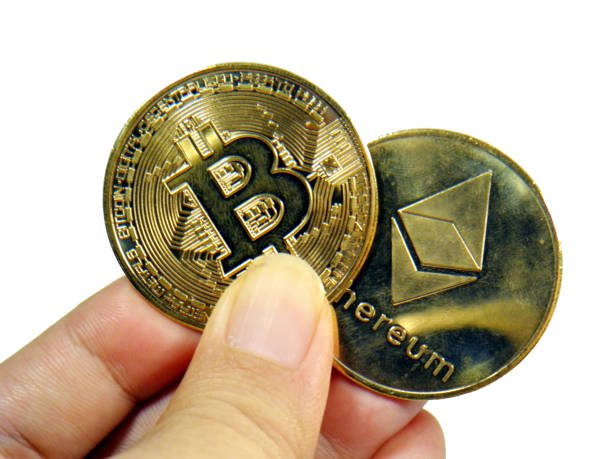
Comparing Bitcoin vs Ethereum as if they’re competing for the same job is the mistake underneath most of this debate. One is a fixed-supply asset with no cash flow. The other is a platform that produces yield and burns its own supply based on usage. They’re different asset types that happen to share an industry.
Here’s where each stands in 2026, what actually separates them, and how to think about growth potential without pretending anyone can forecast it.
Where both stand now
| Bitcoin | Ethereum | |
|---|---|---|
| Price (early Aug 2026) | Mid-$60,000s | ~$1,865 |
| All-time high | ~$126,000 (Oct 2025) | ~$4,953 (Aug 2025) |
| Drawdown from peak | ~50% | ~62% |
| Market capitalisation | Roughly $1.3 trillion | ~$225 billion |
| Maximum supply | 21 million, fixed | No cap |
| Native yield | None | ~2.8–3.5% staking |
Note the drawdowns. Ethereum has fallen further than Bitcoin in this cycle, which is the pattern in most downturns — ETH tends to outperform in rallies and underperform in falls. Anyone treating it as “Bitcoin but with more upside” should recognise that the leverage runs both ways.
What each one is actually for
Bitcoin does one thing deliberately. It’s a fixed-supply, decentralised ledger for holding and transferring value. The protocol barely changes, which is the point — predictability is the feature. There’s no yield, no cash flow, no development roadmap that could go wrong.
Ethereum is a programmable settlement layer. Smart contracts let developers build applications on it: decentralised finance, tokenised assets, marketplaces, Layer-2 networks. Total value locked in Ethereum DeFi recently recovered to over $40 billion from a June low around $36 billion.
The investment implication: Bitcoin’s value rests on adoption as a monetary asset. Ethereum’s rests on people actually using the network, which is measurable but also means it competes with other blockchains.
Supply: the cleanest difference
Bitcoin’s 21 million cap is written into the protocol and issuance halves roughly every four years. Nothing about that changes based on usage.
Ethereum has no maximum supply — around 120.7 million ETH circulate. Instead it has a burn mechanism: a portion of transaction fees is destroyed. When network activity is high, more ETH is burned than issued and supply shrinks. When activity is low, supply grows.
So Bitcoin’s scarcity is guaranteed regardless of what happens. Ethereum’s depends on people using it. That’s a meaningful distinction for a long-term thesis, and it’s usually glossed over in comparisons.
Staking: Ethereum’s structural advantage
This is the biggest change since most Bitcoin-versus-Ethereum articles were written.
Roughly 34% of all ETH is now staked — about 41 million coins, secured by around 1.1 million validators, with a staking market value above $77 billion. Yields run approximately 2.8% to 3.5% annually.
Staked ETH is locked, which removes it from tradable supply. Exchange-held ETH fell to a yearly low around 14.9 million coins as institutional custody absorbed it.
Two things follow. First, Ethereum produces something Bitcoin structurally cannot — a native yield, which gives it a valuation anchor closer to an income-producing asset. Second, that yield is currently modest against conventional fixed income, so it isn’t yet compelling on its own.
Staking rewards are usually taxed as income when received, in the US, UK, Canada and Australia — separately from any capital gain when you later sell. The IRS treats staking rewards as taxable on receipt at fair market value. That’s an administrative burden Bitcoin holders don’t have, and it catches people out.
The ETF picture
Both now have spot ETFs, and Ethereum’s have evolved further.
Grayscale’s Ethereum Staking ETF launched on NYSE Arca in April 2026, and BlackRock’s staked ETH product arrived in March — staking a large majority of its holdings and distributing roughly 82% of gross staking rewards to investors monthly. BlackRock’s product drew $100 million on its first trading day.
That’s genuinely novel: an ETF paying a yield derived from securing a blockchain. It moves Ethereum closer to how institutions think about income-producing assets.
But flows have been difficult across both assets. Bitcoin ETFs saw roughly $7.2 billion of outflows across May and June 2026, the worst stretch since launch, and Ethereum ETF flows have been mixed with a small net outflow at the end of July. Our piece on how ETF flows now move prices covers the mechanism, which applies to both.

Growth potential, honestly
Ethereum’s smaller market capitalisation means a given dollar inflow moves it more. At roughly $225 billion against Bitcoin’s $1.3 trillion, the arithmetic favours ETH for percentage upside.
Upcoming upgrades — Glamsterdam and Hegotá — target substantially higher throughput and lower fees. If they land as intended, that supports the usage case.
Analyst forecasts illustrate how little anyone knows. End-2026 Ethereum targets have ranged from around $2,000 to $7,500, with Standard Chartered at the top end and prediction market traders clustering nearer $3,000–$3,500. Bitcoin targets have spanned $82,000 to well above $200,000. When credible analysts differ by a factor of three or more, that’s not forecasting.
What’s more useful is understanding the asymmetry: Ethereum offers more upside and more downside, plus execution risk Bitcoin doesn’t carry. Upgrades can slip. Competing chains can take market share. Layer-2 networks that scale Ethereum also divert fee revenue away from the base layer — a genuine open question about long-term value capture.
The risks that differ
Bitcoin’s risks are mostly external: regulation, macro conditions, competition for speculative capital. Through this cycle it has traded as a risk asset rather than digital gold, falling when rates stayed high — which undercuts the diversification argument. More detail in our analysis of why Bitcoin is down in 2026.
Ethereum’s risks include all of those plus technical ones: upgrade execution, smart contract vulnerabilities in the wider ecosystem, competition from faster chains, and uncertainty over whether Layer-2 growth ultimately benefits or cannibalises the base layer.
Both face regulatory ambiguity, though Ethereum’s staking model has attracted more scrutiny over whether it constitutes a security in some jurisdictions. The SEC’s Investor.gov publishes guidance on how digital assets are assessed and the risks retail investors face.

Which suits which investor
Bitcoin may suit you if you want the simplest thesis, the longest track record, the deepest liquidity, and no dependence on a development roadmap. It’s the more conservative choice within an inherently speculative asset class.
Ethereum may suit you if you’re persuaded by the usage case, want exposure to blockchain applications rather than just a monetary asset, and are comfortable with technical execution risk in exchange for yield and higher potential upside.
Holding both is what most institutional crypto allocations do, typically weighted toward Bitcoin. They aren’t substitutes — one is a bet on digital scarcity, the other on network usage. Holding both means not needing to be right about which thesis wins.
Whatever the split, position sizing matters more than selection. Both fell 50% or more from their peaks within a year. If a 70% fall would affect your life, the position is too large regardless of which you chose.
Frequently asked questions
Will Ethereum overtake Bitcoin?
“The flippening” has been predicted for years and hasn’t happened. Ethereum would need to roughly quintuple relative to Bitcoin. Possible, but there’s no evidence it’s imminent.
Is Ethereum riskier than Bitcoin?
Generally yes. It has fallen further in this drawdown, carries technical execution risk, and faces more direct competition. Higher risk with correspondingly higher potential return.
Should I stake my ETH?
It generates yield on holdings you intend to keep, but funds may be locked, third-party staking services carry counterparty risk, and rewards are taxable as income. Staking ETFs offer exposure without self-custody, at the cost of fees.
Which is better for a beginner?
Bitcoin is simpler to understand and to hold, with fewer moving parts. That’s a reasonable argument for starting there — see our guides on investing in cryptocurrency safely and storing it properly.
The bottom line
Bitcoin is a fixed-supply asset with no cash flow, priced on adoption as digital scarcity. Ethereum is a working network with usage-linked supply and a native yield, priced on whether people keep building on it.
In 2026 both are deep in drawdown, with Ethereum down further. Both have institutional infrastructure that didn’t exist three years ago, and both face capital that has rotated toward artificial intelligence instead.
If you want one, Bitcoin is the simpler thesis. If you want exposure to blockchain being used rather than just held, Ethereum is the more direct expression — with the execution risk that implies. Most people who hold both do so because nobody can reliably tell which thesis pays off, and that’s a defensible reason.
For the wider question of whether either belongs in a portfolio at all, see our assessment of Bitcoin as a long-term investment.
Sources
- IRS — staking rewards taxable as income on receipt
- SEC Investor.gov — how digital assets are assessed and the risks for retail investors
- HMRC — UK treatment of crypto disposals and staking income
Prices, staking participation figures and ETF flow data are as of early August 2026 and change constantly. Analyst price targets cited are published forecasts from named institutions — we quoted the range to show the disagreement, not to endorse any of them.
Last reviewed: 15 August 2026 — sources verified. Prices, staking figures and ETF flow data are from early August 2026 and change daily.
Information only, not investment advice. Prices and network figures are as of early August 2026 and change constantly. Cryptocurrency is highly volatile and you can lose your entire investment. Staking rewards and disposals are taxable in most countries — consult a qualified professional.