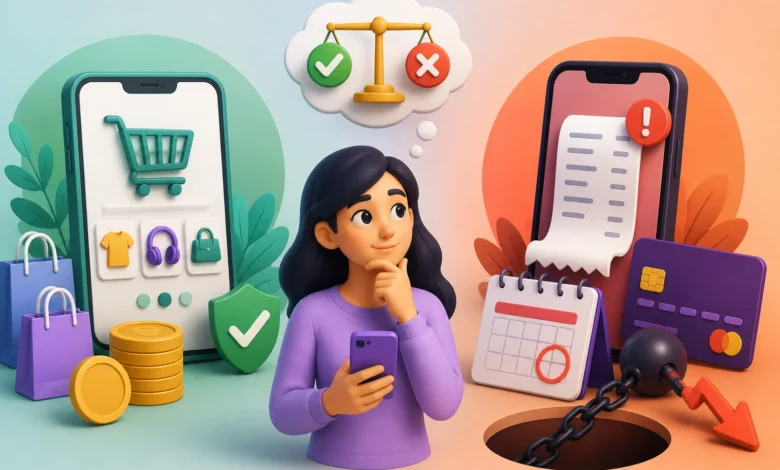
Buy Now Pay Later has changed twice in the past year, and most articles about it are still describing the old picture. The UK brought BNPL under full financial regulation on 15 July 2026. And the widely repeated claim that BNPL now damages your credit score is, in 2026, mostly wrong.
Here’s the accurate position on both — and where the real costs actually sit.
How BNPL works
BNPL splits a purchase into instalments, typically four payments over six weeks, taken automatically from a card. Longer financing plans run over months and sometimes carry interest.
The pitch is instant approval, no hard credit check, no interest and frictionless checkout. All of that is broadly true for the short plans — which is exactly why the risks sit elsewhere.
What changed in the UK on 15 July 2026
BNPL was largely exempt from UK consumer credit rules until this year. That ended.
From 15 July 2026, the Financial Conduct Authority regulates deferred payment credit. Providers including Klarna and Clearpay must now:
- Run affordability checks before approving credit, as banks do for loans
- Provide clear credit agreements in plain language, stating the true cost of borrowing
- Operate complaints procedures with access to the Financial Ombudsman Service
That last point matters most. If a BNPL provider treats you unfairly, you now have a free route to escalate it. Around 10 million people in the UK used BNPL in 2025, most of them without those protections.
The practical effect for consumers: approvals may become slightly harder, and the terms you’re shown should be clearer. Current details are published by the FCA.

The credit score myth
This is where most coverage gets it wrong, and the correction is worth understanding properly.
Reporting and scoring are different things. A provider sending data to a credit bureau doesn’t mean that data affects the score a lender pulls.
Where the US providers actually stand:
| Provider | What it reports |
|---|---|
| Affirm | All plans including Pay in 4, to Experian and TransUnion since April 2025 |
| Klarna | Longer monthly financing only — Pay in 4 stays off your file |
| Afterpay | No BNPL furnishing beyond a limited pilot |
Then the second step. FICO announced two BNPL-enabled scores — FICO Score 10 BNPL and 10 T BNPL — on 23 June 2025, expected that autumn. As of mid-2026 they still aren’t in market, and mainstream lenders aren’t underwriting on them. Bureaus receiving BNPL data currently tag it and keep it out of the scores lenders read.
So if you’re using BNPL specifically to build credit, it isn’t working. And if you’re avoiding it purely out of fear for your score, that fear is aimed at the wrong risk.
Where BNPL genuinely damages your credit
One route, and it’s serious: default and collections.
Miss enough payments and the account can be passed to a collection agency. A collection entry is reported and is scored, and it stays on your file for six to seven years depending on the country. That’s real, lasting damage — arriving through the back door rather than through routine reporting.
UK readers should also note that with FCA regulation in force, the reporting landscape there is likely to develop further. Treat the current position as a snapshot.
The costs that actually bite
Late fees. Charged per missed instalment, and they compound across plans. A £40 purchase with repeated missed payments can end up costing considerably more, and the fee is a large percentage of a small purchase.
Overdraft and NSF charges. This is the underrated one. BNPL payments auto-debit on a schedule you may have forgotten. If the balance isn’t there, your bank charges you — often more than the BNPL late fee itself. People with several plans running frequently pay bank fees rather than BNPL fees.
Deferred interest on longer plans. Short Pay in 4 plans are genuinely interest-free. Longer financing frequently isn’t, and some plans charge accrued interest retroactively if any balance remains at the end. Read which product you’re being offered.
Returns and refunds. A refund doesn’t automatically cancel the payment plan. You can be making instalments on something you’ve already sent back while the refund works its way through — a known friction point with these products.
The overspending mechanism
The strongest argument against BNPL isn’t fees. It’s that splitting a price makes it feel smaller.
A £200 jacket presented as “4 payments of £50” changes the purchase decision. That’s not an accident — it’s what the product is designed to do, and research on instalment framing consistently shows people spend more when prices are broken up.
The compounding problem is stacking. Four plans across three providers is £150 a month of committed spending you never budgeted for, arriving on dates you don’t track, and no single provider sees the full picture.
The affordability checks now required in the UK address part of this, but they assess each application individually. Your total BNPL exposure across providers may still be invisible.
BNPL versus a credit card
| BNPL | Credit card | |
|---|---|---|
| Interest on short plans | Usually 0% | 0% only if cleared monthly |
| Approval | Instant, soft or no check | Full application |
| Builds credit | Not meaningfully, in 2026 | Yes |
| UK Section 75 protection | No | Yes, £100–£30,000 |
| Rewards | Rarely | Often |
The Section 75 gap matters more than people realise. Buy a £500 item on a UK credit card and the issuer is jointly liable if the retailer fails to deliver. Buy it with BNPL and you don’t have that. For anything expensive or from an unfamiliar retailer, that protection is worth more than spreading the cost.
A credit card cleared in full each month costs nothing and does everything BNPL does, with better protection — see our comparison of how card and loan borrowing compare.
Using it without getting hurt
Cap yourself at one active plan. Stacking is where the damage happens, not any single purchase.
Diary every payment date and keep the linked account funded. Most BNPL costs are actually bank fees.
Only use it for things you’d buy anyway. If the instalment framing is what made the purchase feel possible, that’s the signal to stop.
Check whether it’s Pay in 4 or longer financing. The interest terms are completely different.
Keep a cash buffer. Relying on BNPL because you can’t afford something this month is borrowing without calling it borrowing — see our emergency fund guide.
Country positions
United Kingdom. Fully FCA-regulated since 15 July 2026, with affordability checks and Ombudsman access.
United States. Oversight has shifted with regulatory priorities. Reporting varies sharply by provider, and BNPL-enabled FICO scores aren’t yet in use. The Consumer Financial Protection Bureau publishes consumer guidance.
Australia. BNPL now sits within the credit licensing regime, with providers required to hold a credit licence.
Europe. The revised Consumer Credit Directive extends consumer credit rules to BNPL and smaller agreements as member states implement it.
Frequently asked questions
Does BNPL affect my credit score?
Routine use, mostly not — as of 2026 the BNPL-enabled FICO scores aren’t in market and bureaus keep the data out of standard scores. But a defaulted account sent to collections does appear and is scored.
Can I use BNPL to build credit?
Not effectively right now. A secured card or credit builder card is both reported and scored, which BNPL currently isn’t — see our guide to credit builder cards.
What if I return an item?
Contact the provider directly. Refunds don’t automatically stop the payment schedule, and you may keep paying until it’s processed.
Is BNPL cheaper than a credit card?
For a short plan you repay on time, both cost nothing. The card adds purchase protection and rewards. BNPL only wins if you’d otherwise carry a card balance.
The bottom line
BNPL is genuinely interest-free on short plans repaid on schedule. The costs come from late fees, bank overdraft charges on forgotten auto-debits, and stacking multiple plans until the monthly total is larger than you’d have agreed to borrow.
UK users now have real protections that didn’t exist a month ago — affordability checks, clear agreements, and Ombudsman access. Use them.
And don’t use BNPL to build credit, because in 2026 it doesn’t. Its one serious credit risk is a default reaching collections, which is a back-door route to damage that lasts years.
Sources
- Financial Conduct Authority — the deferred payment credit regime effective 15 July 2026
- Consumer Financial Protection Bureau — US guidance on BNPL products
- Financial Ombudsman Service — the escalation route now available to UK BNPL users
Credit reporting practices described here come from each provider’s own published policies, which differ significantly between Affirm, Klarna and Afterpay and are changing rapidly. Verify current practice with your provider.
Last reviewed: 15 August 2026. BNPL regulation and credit reporting are changing rapidly — we review this article when they do.
General information only, not personalised financial advice. BNPL regulation and credit reporting practices are changing rapidly — verify current rules with your regulator and the provider’s own terms.