
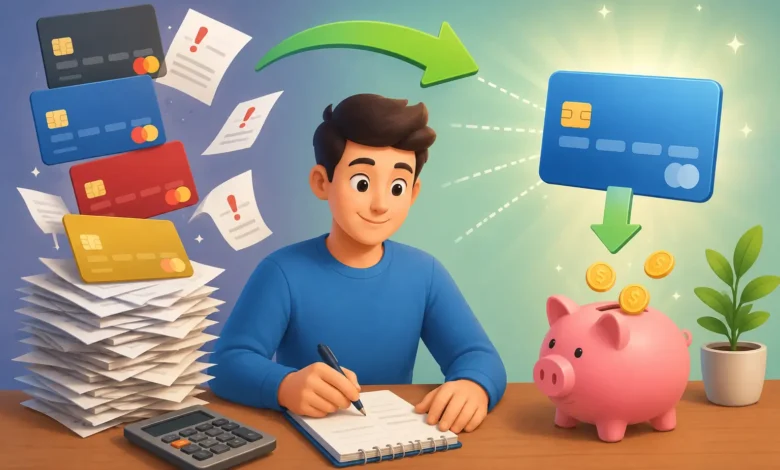
Debt consolidation gets sold as a way to lower your monthly payment, and it usually does. But a lower payment and less debt are two different things — and confusing them is how people end up consolidating twice.
Here’s how each method actually works, the arithmetic that tells you whether it helps, and the tax trap that catches people who choose settlement instead.
What consolidation does and doesn’t do
Consolidation combines multiple balances into one payment. It changes the structure of your debt — the rate, the term, the number of payments.
It does not reduce what you owe. If your balances total $18,000 before, they total $18,000 after.
That matters because the main benefit — a lower monthly payment — can come from two very different places:
- A lower interest rate, which genuinely saves money
- A longer repayment term, which lowers the payment while increasing total interest
Many consolidation offers do both. Always ask which one is producing the lower payment.
The number that tells you the truth
Ignore the monthly payment and compare total interest paid.
Take $15,000 of credit card debt at 24% APR. Paying $450 a month, you’d clear it in roughly four years and pay around $6,600 in interest.
Consolidate into a five-year personal loan at 12% and the payment drops to about $334 — but you’d pay roughly $5,000 in interest across five years. Better, but less dramatic than the payment drop suggests.
Now stretch that same loan to seven years. The payment falls to around $265, and total interest rises to roughly $7,200 — more than you’d have paid on the credit cards.
Same debt, same rate, worse outcome, better-looking monthly payment. That’s the trap.

The four main methods
| Method | Best for | Main risk |
|---|---|---|
| Personal loan | Fair to good credit, larger balances | Origination fees, long terms |
| Balance transfer card | Good credit, balance clearable in 12–21 months | Rate jumps when promo ends |
| Home equity loan / HELOC | Homeowners with equity | Your home is collateral |
| Debt management plan | Struggling to keep up at all | Accounts usually closed |
Personal loans give a fixed rate, a fixed payment and a definite end date. Watch for origination fees, often 1–8% deducted from the amount you receive. Rates depend heavily on credit score.
Balance transfer cards offer 0% for a promotional period, typically 12 to 21 months, with a transfer fee of around 3–5%. Excellent if you can clear the balance inside the window; expensive if you can’t, since the standard rate then applies to whatever remains. Our head-to-head comparison of balance transfers versus personal loans covers when each wins.
Home equity borrowing offers the lowest rates because your house secures it. That’s also the problem: you’re converting unsecured debt into debt that can cost you your home, and stretching a three-year problem across fifteen or thirty years of interest.
Debt management plans come from nonprofit credit counselling agencies. They negotiate reduced rates with creditors and you make one payment to the agency, typically clearing the debt in three to five years. Most accounts get closed as a condition. Legitimate agencies charge modest setup and monthly fees — anything demanding large upfront payments isn’t one.
Debt settlement is different — and taxable
Worth separating clearly, because the marketing blurs it.
Debt settlement means negotiating to pay less than you owe. Companies typically tell you to stop paying creditors while they build a fund, which damages your credit substantially and can trigger collections or lawsuits in the meantime.
And here’s the part almost nobody mentions: forgiven debt is generally treated as taxable income in the US. If a creditor writes off $8,000, you may receive a 1099-C and owe income tax on that amount. People who settle sometimes discover a tax bill they hadn’t budgeted for.
Exceptions exist, notably insolvency, but they require documentation. The IRS publishes the rules on cancellation of debt income.
Should you use retirement savings?
The short answer is almost never.
A 401(k) loan avoids credit checks and the interest goes back to your account, which sounds appealing. But if you leave your job, the balance typically becomes due quickly, and unpaid amounts are treated as a distribution — taxes plus a penalty if you’re under 59½.
An outright withdrawal is worse: taxes, penalties, and permanent loss of decades of compounding on that money.
Consolidating consumer debt by damaging retirement is trading a solvable problem for an unsolvable one.
Who qualifies for what
Consolidation options narrow sharply as credit scores fall, which is the frustrating part — the people who need it most often qualify for least.
Roughly:
- 740+ — best personal loan rates, longest 0% balance transfer offers
- 670–739 — personal loans available at moderate rates, shorter transfer offers
- 580–669 — personal loans available but rates may not beat your cards; check carefully
- Below 580 — a debt management plan through a nonprofit agency is usually the realistic route
If you’re close to a threshold, spending three months improving your position can change the rate you’re offered materially — see our guide to improving your credit score quickly. Utilization moves fastest.

The step that determines whether it works
Consolidation fails for one reason more than any other: the cards get used again.
You consolidate $15,000, the cards show zero balances, and within eighteen months there’s $8,000 back on them — plus the consolidation loan. That’s a worse position than before.
Practical safeguards:
Remove stored card details from shopping sites and phone wallets.
Keep the accounts open but unused. Closing them raises your utilization and shortens your credit history. Keep one for a single small recurring charge on autopay.
Build a starter emergency fund first. Without one, the next car repair goes straight back on a card. Even one month of expenses breaks the cycle — see our emergency fund guide.
Understand why the debt built up. If it was a one-off medical event, consolidation solves it. If it was spending above income, consolidation just resets the clock.
Effect on your credit score
Short term, expect a small dip from the hard inquiry and the new account lowering your average account age.
Medium term it usually helps: paying cards to zero drops your utilization sharply, which is roughly 30% of your score and the fastest-moving factor. Installment loans are also weighted differently from revolving debt.
The risk is behavioural rather than mechanical. Rebuilding card balances after consolidating pushes utilization back up while the loan sits alongside it.
Warning signs of a bad offer
Upfront fees before any service. Charging fees before settling debt is prohibited in the US.
Guaranteed results. Nobody can guarantee creditors will agree to anything.
Pressure to decide immediately. Legitimate lenders hold offers for days.
Advice to stop paying creditors. This is the settlement model, and the consequences should be explained clearly rather than glossed over.
Vagueness about total cost. Any legitimate offer will state the APR, all fees and the total repayable in writing.
Free credit counselling from a nonprofit agency is genuinely better than most paid alternatives. The Consumer Financial Protection Bureau explains how to find one and what to expect.
Frequently asked questions
Does consolidation reduce what I owe?
No. It changes the rate, term and number of payments. Only settlement or bankruptcy reduces the principal, and both carry serious consequences.
Balance transfer or personal loan?
Transfer if you can realistically clear the balance during the 0% period. Loan if you need longer or want a fixed payment. Compare the transfer fee against the interest saved.
Will it hurt my credit?
Briefly, then usually help — provided you don’t rebuild the card balances. That’s the whole test.
What if I can’t qualify for anything?
Contact a nonprofit credit counselling agency. Debt management plans don’t require good credit, and creditors frequently agree to reduced rates through them.
The bottom line
Work out your total interest under each option rather than comparing monthly payments. A longer term always lowers the payment and often raises the cost.
Choose a balance transfer if you can clear it inside the promotional window, a personal loan if you need a fixed payment over three to five years, and a nonprofit debt management plan if you can’t qualify for either.
Then treat the freed-up cards as closed in practice, and get one month of expenses saved before anything else. Consolidation is a tool for restructuring debt you’ve stopped adding to — for anyone still adding, it’s an expensive delay. Our guide to what credit card debt actually costs covers where the leaks usually are.
Sources
- IRS Topic 431 — cancellation of debt income and the 1099-C
- Consumer Financial Protection Bureau — debt settlement rules and finding nonprofit credit counselling
- IRS retirement plan loans — 401(k) loan repayment on separation from employment
Interest rates, origination fees and promotional terms come from lenders’ own published rates and vary by credit profile. Verify your actual offer before comparing.
Last reviewed: 15 August 2026. Rates and tax rules change — we review this article when they do.
General information only, not personalised financial or tax advice. Rates, fees and tax treatment vary and change. Consider free nonprofit credit counselling before paying anyone for debt help.